
Post Summary
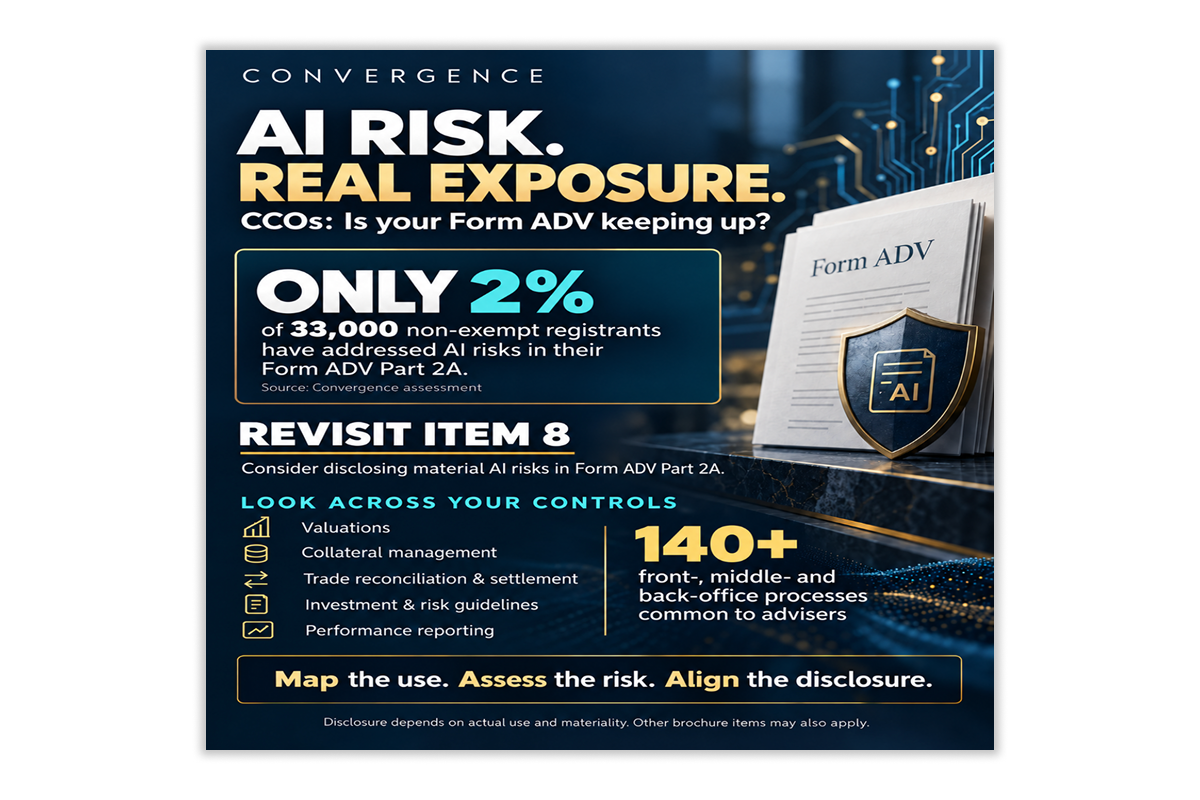
According to Convergence’s analysis, only 2% of 33,000 non-exempt registrants have addressed AI risks in their Form ADV Part 2A.
Whether Part 2A adequately explains material AI risks affecting investment methods, strategies, and non-investment processes and the related risk of loss, and whether disclosures reflect actual use and material risks.
AI risk can be embedded in third-party providers’ systems, and errors in those functions can affect client assets, fees, and reported results.
Map your AI use, assess the risk, and align your disclosures.
Only 2% of 33,000 non-exempt registrants have addressed AI risks in their Form ADV Part 2A. Quite a shock to see that so few believe that material risks exist across the roughly 140+ front-, middle- and back-office processes that are common to advisers.
What should CCOs consider about AI in Form ADV Part 2A?
AI governance and data quality go hand in hand, and CCOs should consider whether their Form ADV Part 2A adequately explains material AI risks affecting their investment methods, strategies and non-investment processes and related risk of loss. Disclosures should reflect actual use and material risks.
Have you considered the AI risk in your third-party providers' systems?
And have you fully considered the AI risk embedded in your third-party providers' systems? Errors in these functions can affect client assets, fees and reported results.
Map your AI use. Assess the risk. Align your disclosures.
Map your AI use. Assess the risk. Align your disclosures.
Contact Convergence for our AI Risk Disclosure and Governance Guidance.
Request the AI Risk Disclosure and Governance Guidance.
Or book time with our team.
About the data
The 2% figure comes from Convergence's analysis of Form ADV Part 2A filings by non-exempt registrants as of October 20, 2026.
Key Points
What does the Form ADV AI disclosure gap look like?
- The figure. Only 2% of 33,000 non-exempt registrants have addressed AI risks in their Form ADV Part 2A.
- The source. The figure comes from Convergence’s analysis.
- The universe. Non-exempt registrants.
- The scope. Roughly 140+ front-, middle-, and back-office processes are common to advisers.
- The reaction. Convergence’s John Phinney calls it quite a shock that so few believe material risks exist across those processes.
What should CCOs consider?
- Governance and data. AI governance and data quality go hand in hand.
- Coverage. Whether Part 2A adequately explains material AI risks affecting investment methods, strategies, and non-investment processes.
- Risk of loss. The disclosure should address the related risk of loss.
- Actual use. Disclosures should reflect actual use.
- Material risks. Disclosures should reflect material risks.How does third-party AI risk fit in?
How does third-party AI risk fit in?
- Where it sits. AI risk can be embedded in third-party providers’ systems.
- The question. Have you fully considered it?
- Client assets. Errors in these functions can affect client assets.
- Fees. They can also affect fees.
- Reported results. And they can affect reported results.
What is the recommended approach?
- Map. Map your AI use.
- Assess. Assess the risk.
- Align. Align your disclosures.
- Next step. Contact Convergence for its AI Risk Disclosure and Governance Guidance.
- Who it is for. The post is addressed to chief compliance officers.