
Post Summary
Whether they are spending too much time playing with market data and building business intelligence, and not enough time acting on it.
New fund launches, adviser expansion, outsourcing events, service-provider changes, and rising client complexity.
It turns those signals into actionable intelligence before they show up in revenue reports.
Senior leaders get faster targeting and better client selection, while Fund Administrators, Auditors, and private equity investors get clearer visibility into organic growth and management execution.
Not building more business intelligence, but acting earlier on the intelligence already available.
What Question Should Fund Administrators and Auditors Be Asking About Their Data?
Fund Administrators and Auditors should be asking themselves a simple question:
"Are we spending too much time playing with market data and building business intelligence — and not enough time acting on it?"
What Revenue Growth Signals Are Already Visible in Convergence's Data?
Revenue growth signals are already visible in our data: new fund launches, adviser expansion, outsourcing events, service-provider changes, and rising client complexity.
What Does Convergence Do With These Signals?
Convergence has created and turns those signals into actionable intelligence before they show up in revenue reports.
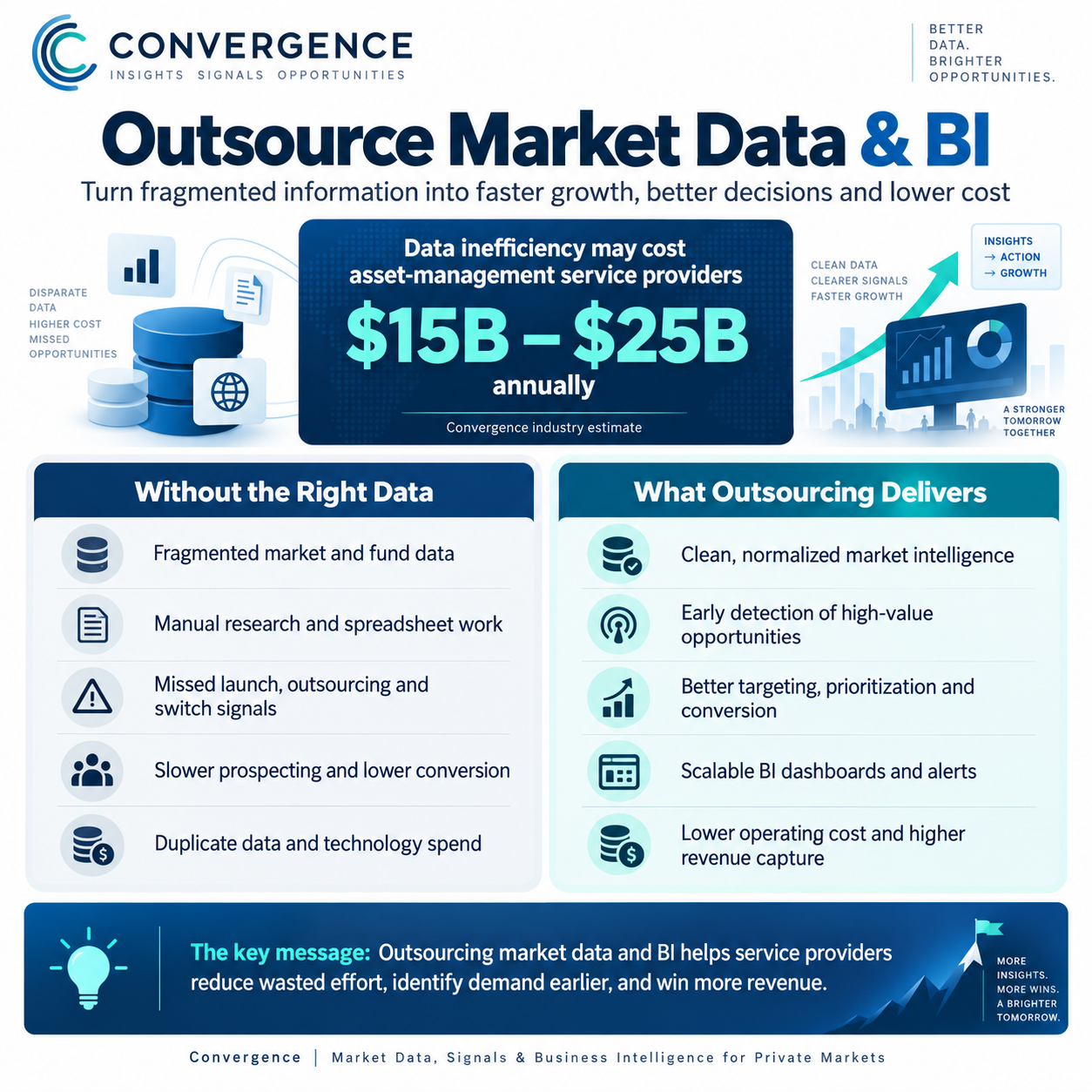
Who Benefits, and How?
For senior leaders, that means faster targeting and better client selection and for Fund Administrators and Auditors and private equity investors, it means clearer visibility into organic growth and management execution.
What Is the Real Advantage?
The advantage is not building more BI. It is acting earlier!
Key Points
What core question does this piece pose to Fund Administrators and Auditors?
- The question is framed as deceptively simple: The piece states Fund Administrators and Auditors "should be asking themselves a simple question."
- The question specifically contrasts data activity with data action: "Are we spending too much time playing with market data and building business intelligence — and not enough time acting on it?"
- This framing implies BI-building itself can become a distraction: The question does not challenge whether BI is valuable, but whether time spent building it is displacing time spent acting on what it reveals.
What specific revenue growth signals does this piece identify, and where do they come from?
- Five distinct signal categories are named directly: "New fund launches, adviser expansion, outsourcing events, service-provider changes, and rising client complexity."
- These signals are described as already present in Convergence's data: The piece states these signals "are already visible in our data," framing them as currently detectable rather than requiring new data sources.
- The signals span both growth and complexity dimensions: New fund launches and adviser expansion represent growth-oriented signals, while service-provider changes and rising client complexity represent risk/complexity-oriented signals, and outsourcing events could reasonably be read as either.
What does Convergence do with these signals, and what is the timing advantage described?
- Signals are converted into actionable intelligence: The piece states Convergence "turns those signals into actionable intelligence."
- A specific timing advantage is named directly: This happens "before they show up in revenue reports," meaning the intelligence is available ahead of when the same information would surface through standard financial reporting.
- This timing framing is consistent with the "earlier signal" theme running through Convergence's related pieces: Multiple pieces in this content set (Earlier Revenue Signals, Likely to Switch, Likely to Outsource) share this same before-it's-visible framing.
Who benefits from this approach, and what specific benefit does each group receive?
- Senior leaders receive two named benefits: "Faster targeting and better client selection."
- Fund Administrators, Auditors, and private equity investors receive a different named benefit: "Clearer visibility into organic growth and management execution."
- The benefits are role-specific rather than generic: The piece does not describe a single universal benefit, but tailors the value proposition to what each named audience segment would specifically use the intelligence for.
What does this piece identify as the real competitive advantage, and how does it reframe the value of BI itself?
- The advantage is explicitly not more BI: The piece states directly, "the advantage is not building more BI."
- The advantage is instead framed around timing of action: "It is acting earlier!"
- This closing line functions as the piece's thesis statement: It directly answers the opening question about whether firms spend too much time building BI and not enough time acting on it, closing the loop between the piece's opening challenge and its conclusion.