

Post Summary
The research analyzed Form ADV Part 2 expense disclosures across more than 2,600 advisers, of which almost half, 1,288, were hedge funds. The remainder were private equity, real estate, venture capital, and hybrid funds, included for comparison purposes.
Convergence separated advisers into peer groups and built a dynamic dictionary of the terms advisers use to describe their expense disclosures, then identified which expense categories were disclosed consistently within a peer group, common, and which were disclosed by only a minority, uncommon.
Hedge funds were the top disclosers across six of the ten most frequently used expense categories, including audit expenses at 100 percent, investment-related expenses at 94 percent, fund accounting and administration at 92 percent, legal expenses at 82 percent, general administration at 79 percent, and performance fees at 78 percent.
Hedge funds represented the highest percentage among four of the ten less common expense categories: adviser employee compensation at 8.7 percent, data and data management at 16.6 percent, printing expenses at 17.9 percent, and technology at 23.8 percent.
Investors have raised concerns because several of these categories, particularly adviser compensation, data, and technology costs, are ones many would expect to be treated as a management company expense, covered by the management fee, rather than charged directly to the fund.
From HFM Week, Oct 15, 2015
Less Common Expenses Funds Are Levying On Investors
HFMWeek/Convergence investigation highlights the most popular “uncommon” expenses funds are charging
BY CHRIS JOSSELYN
The fund expense practices of hedge funds have come under scrutiny in recent times, not least as regulators have taken a tougher stance on con icts of interest and disingenuous, inconsistent and unclear approaches by managers.
Investors, too, are perhaps paying more attention to the disclosures in Part 2 of Form ADVs before investing in order to avoid being liable for expenses that they may feel are not their business to pay for.
However, new research of SEC data, conducted by data analytics firm Convergence on behalf of HFMWeek, suggests that parts of the hedge fund sector are still not being as consistent in the type of costs they are disclosing as fund expenses as some investors would like them to be.
Investors who have been shown the research have also highlighted the prevalence of expenses that they would consider as being a management company, rather than a fund, expense.
Breaking Down Expenses
The research is based on the Form ADVs of more than 2,600 advisers, of which almost half (1,288) are hedge funds. The remainder are private equity funds, real estate funds, venture capital funds, and hybrid funds, which were researched for comparison purposes.
Convergence collected the data by parsing expense disclosures from Part 2 of Form ADVs and creating a dynamic dictionary of term objects that the advisers use to describe their expense disclosures.
Convergence co-president John Phinney says: “After separating the funds into peer groups, we identify what we call ‘common’ and ‘less common’ expense group disclosures among peers in order to determine any unusual tendencies.”
Of the most common expenses, hedge funds had the highest level of advisers disclosing across six of the 10 most frequently used categories, suggesting they disclose more consistently across these common expense groups. The common categories where hedge funds were the top disclosers were audit expenses (100% of the hedge funds analysed disclosed this), fund accounting and administration (92%), general administration (79%), investment related (94%), legal expenses (82%), and performance fees (78%).
For many of these “common expenses”, there is little debate about these being charged to the fund.
“Anything that’s providing a direct service to the fund is clearly a fund expense,” Gordon Barnes, senior director of business risk management at Cambridge Associates, tells HFMWeek.
“The fund auditor clearly should be charged to the fund. Fund administrator, same thing. Legal, organizational costs, the setting up of the fund and ongoing structural maintenance are certainly are a cost of the fund. And directors – they’re representing the fund investors, and that’s clearly a fund expense.
Hedge Funds and Uncommon Disclosures
When it came to less common expenses – often costs traditionally associated with the management company – hedge funds represented the highest percentage of four of the top 10 less common expense categories.
The categories of unusual expense disclosures that were more common in hedge funds than in other asset classes may leave some investors puzzled as to what rationale there is behind charging them to the fund: adviser employee compensation (8.7% of the hedge funds analysed disclosed that they may charge investors for this), data and data management (16.6%), printing expenses (17.9%) and technology (23.8%).
Other ‘less common’ categories include communications expenses, compliance expenses, marketing, pricing and valuation services, subscriptions, and adviser overhead expenses.
“Then you get into things that could be seen as overhead for a business, and there’s a kind of in-between,” explains Cambridge Associates’ Barnes.
“Research is an interesting one; some groups argue that research is [a fund expense] as it provides a benefit to investors to have a Bloomberg terminal and things like that.”
This becomes more ambiguous where managers receive services through “soft dollars”, where brokers provide certain amenities in exchange for the managers directing business their way.
“What’s tricky here is that they could be charged to the fund, in the form of a direct fund expense, or through soft dollars – ultimately it’s being paid by investors because they’re essentially overpaying for commissions and getting credit back from their brokers to spend on certain research related-tools,” adds Barnes.
Most allocators are aware of and comfortable with the concept of soft dollars. However, what they demand is transparency.
Another area that is likely to come on to the radar in future is any charges associated with cash management, given the regulatory pressures on institutions holding cash.
“We’re entering a world where [cash management costs] are going to become a reality and so the additional costs associated with MMFs or cash custody is something that will be absorbed into a fund expense,” Daniel Burdett, senior analyst within Aksia Europe’s ODD team told HFMWeek.
Research-Related Ambiguity
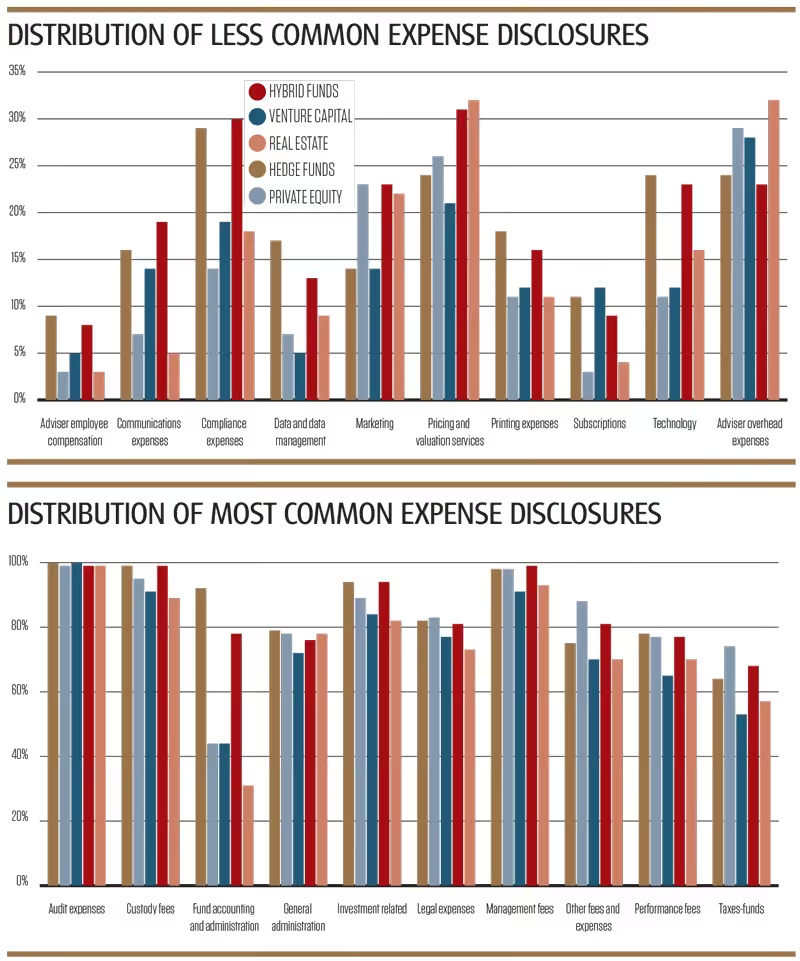
Unusual Fund Expenses: Investor Concern Over HFM Week / Convergence Research
Research-related travel expenses is another ambiguous area. “Travel expenses for the analysts to go see the companies and do due diligence on them – that used to be a lot more common,” says Cambridge Associates’ Barnes.
“With travel, there’s potential conflicts that can arise. At the end of the day, why don’t you just charge a higher management fee? It would be a lot more transparent – if you need this extra travel cost, why don’t you just add 10 basis points to your management fee and be very transparent?”
Regulators are focusing on this as it becomes a greater investor concern. The SEC requires that disclosures be specific in ADV documents, and in 2012 it charged long/short equity hedge fund Lion Capital Management and its manager Hausmann-Alain Banet for using investor funds to pay unauthorised personal and business expenses.
Trade body Aima has also published guidance on hedge fund expense due diligence, in which it highlights that “getting the full picture of the various expenses is rarely easy and requires careful review and analysis during initial and ongoing investment manager due diligence”.
“All of the fees outside of the management fees are generally not disclosed very well,” says Mark Renz, CIO at Florida-headquartered Socius Family Office, which has $200m in AuM and $150m under advisement.
“It’s difficult to break out where a lot of the underlying fees come from – typically they’re buried in financial statements and other disclosures, and even there it’s not always very clear.
“Many people are just starting to wake up to a lot of this. People talk about 2&20, but really it’s not 2&20; it’s far more than two because typically that 2% management fee doesn’t actually cover any of the expenses. You could say it’s an advisory fee, just allocated to the investment managers as pure compensation, but it doesn’t cover any of the expenses – it’s not apples to apples.”
Renz adds that managers have a lot of scope for being creative in categorizing expenses.
“On the partnership side they have a lot of discretion – there’s no best practice or standard practice for disclosing these fees, and there’s a lot of discretion – it’s really up to the manager as to what they want to charge and how they charge it. The statements are so broad that it gives them the latitude to shove whatever they want in there.”
The research suggests that the depth, breadth, and quality of expense disclosure varies widely between managers. However, it does highlight the prevalence of certain expenses many investors would hope to see paid for by the management company being paid at fund level.
Convergence’s John Phinney says: “This could be due to a creeping of expenses to the fund that were previously borne by the adviser because of a trend towards lower management fees and increasing regulatory, compliance and investor expenses or simply an attempt by advisers to create more distinction between expenses related to the investment versus non-investment process.”
This move may also have been triggered by investor activism aimed at lowering fees, according to Phinney. “Advisers are under more fee and expense pressure driven by investor activism and greater regulation and may seek to offset, in part, the negative impact on management fees by charging the funds they advise more expenses that may be considered a cost of the fund,” he explains.
“At the end of the day, it’s not only an issue of transparency, but it’s [also] an issue of consistency,” concludes Socius’s Renz. “There has been something of a change – some managers have been willing to reduce their fees or negotiate – I just don’t think that it has translated over to the expense side.”
Conversely, Cambridge Associates’ Barnes says unusual expenses that many investors think should be charged to the manager, rather than the fund, are more prevalent in older managers “that have been around for 15 to 20 years”, rather than newer vehicles.
He adds: “When they launched this was standard practice, and over time, some of them are still doing it, especially the ones that have great performance, whereas new fund launches over the past couple of years, are pretty much in line.
“These businesses are very profitable, and it’s an expense of doing business. There are certain circumstances where we see a several-billion-dollar fund, and they’re extremely profitable. There’s no reason to be passing through a basis point here and a basis point there of certain overhead expenses – it doesn’t make sense.”
Key Points
What was the scope and methodology of the Convergence research for HFM Week?
- The sample covered more than 2,600 registered advisers: Nearly half, 1,288, were hedge funds, with the remainder made up of private equity, real estate, venture capital, and hybrid funds included for comparison.
- The data source was Form ADV Part 2 expense disclosures: Convergence parsed the expense disclosure sections of each adviser's Form ADV rather than relying on self-reported summaries or investor-facing marketing materials.
- A dynamic dictionary standardized inconsistent terminology: Because advisers describe similar costs using different language, Convergence built a dictionary of term objects to classify disclosures consistently across the full sample.
- Peer grouping came before classification: Advisers were separated into peer groups before any expense category was labeled common or uncommon, since what counts as standard practice varies by fund size and strategy.
- The output distinguished common from uncommon disclosures: For each peer group, the research identified which expense categories the majority of advisers disclosed and which only a minority disclosed, isolating the categories worth investor attention.
Which expense categories showed the most consistent, common disclosure among hedge funds?
- Hedge funds led six of the ten most frequent expense categories: Audit expenses, fund accounting and administration, general administration, investment-related expenses, legal expenses, and performance fees were all disclosed by hedge funds at the highest rate among the fund types studied.
- Audit expenses were disclosed by 100 percent of hedge funds analyzed: This was the most consistently disclosed category in the entire study, reflecting near-universal agreement that fund audit costs belong to the fund.
- Investment-related expenses followed closely at 94 percent: Costs directly tied to executing the investment strategy were disclosed by the large majority of hedge fund advisers in the sample.
- Fund accounting and administration reached 92 percent: Administration costs, alongside audit, represent the categories with the least ambiguity about whether the fund or the manager should bear the cost.
- Legal expenses and general administration rounded out the common categories: Disclosed at 82 percent and 79 percent respectively, these categories were described in the research as ones with little debate about their treatment as fund expenses.
Which uncommon expense categories did hedge funds disclose more than other fund types, and by how much?
- Technology expenses were the largest gap identified: 23.8 percent of hedge funds analyzed disclosed technology as a fund expense, the highest rate among the four standout uncommon categories.
- Printing expenses were disclosed by 17.9 percent of hedge funds: A comparatively minor cost in dollar terms, but one that reinforced the broader pattern of hedge funds passing through categories more typically treated as overhead.
- Data and data management costs were disclosed by 16.6 percent of hedge funds: This category drew particular investor attention given the growing role of data infrastructure and Bloomberg-style terminal costs in day-to-day fund operations.
- Adviser employee compensation was disclosed by 8.7 percent of hedge funds: The smallest by percentage among the four standout categories, but arguably the most sensitive, since it involves charging the fund for costs of employing the adviser's own staff.
- Other uncommon categories noted in the research included communications, compliance, marketing, pricing and valuation services, subscriptions, and adviser overhead expenses, though these were not broken out with specific percentage figures in the original research.
Why do industry sources consider some of these categories ambiguous rather than clearly right or wrong?
- Research and Bloomberg-style costs sit in a genuine gray area: Sources in the research noted that a Bloomberg terminal benefits investors directly through better research, which some argue justifies fund-level treatment, while others see it as ordinary overhead of running an investment business.
- Soft dollar arrangements blur the line further: Costs paid through commission credits rather than a direct expense line can amount to the same charge to investors, disclosed in a different form, which sources described as a transparency issue rather than a clear violation.
- Cash management costs were flagged as an emerging category: Regulatory pressure on institutions holding cash was expected, according to sources in the research, to push more cash-related costs into fund expense disclosures going forward.
- Travel expenses for investment due diligence were cited as a related gray area: One source suggested that if additional travel costs are needed, a more transparent approach would be to raise the management fee rather than pass the specific expense through to the fund.
- The SEC has taken enforcement action in cases involving expense mischaracterization: The research referenced a 2012 SEC case against a hedge fund manager for using investor funds to pay unauthorized personal and business expenses, illustrating the regulatory stakes underlying the broader disclosure debate.
What did industry sources identify as the drivers behind inconsistent expense disclosure?
- Management fee compression was cited as a leading factor: As investor activism and competitive pressure have pushed management fees lower, some advisers may be shifting costs previously absorbed by the adviser onto the fund to offset the impact.
- Rising compliance and regulatory costs were named as a contributing pressure: Greater regulatory scrutiny has increased the cost of running an advisory business, and sources suggested some of that increase is flowing into fund-level expense disclosures.
- Longer-tenured managers were noted as more likely to carry forward older practices: Sources observed that unusual expense practices were more prevalent among managers operating for fifteen to twenty years, often established when such practices were standard, while newer fund launches were largely in line with cleaner disclosure norms.
- A lack of standardized disclosure requirements leaves room for discretion: Form ADV does not prescribe a single standard for classifying an expense as fund-level versus adviser-level, giving advisers latitude in how they characterize the same underlying cost.
- Sources described the issue as one of consistency as much as transparency: Even where individual disclosures are technically compliant, the research noted that the broader industry has not applied the same discipline to expense treatment that it has begun applying to fee negotiation.
What should investors take away from this research when evaluating a fund's expense disclosures?
- An unusual expense category is a question, not automatically a red flag: Sources in the research emphasized that context matters, and a disclosure outside the norm deserves a follow-up question rather than an automatic disqualification.
- The comparison only means something against the right peer group: A cost that is standard for one peer group, defined by size and strategy, may be genuinely unusual in another, making peer-group context essential to interpreting any single disclosure.
- Headline fee terms do not capture the full cost picture: Sources noted that focusing only on the 2 and 20 structure without examining underlying expense disclosures gives an incomplete view of what an investor is actually paying.
- Discretion in classification means investors should ask advisers directly: Because Form ADV does not standardize fund versus manager expense treatment, sources suggested investors are better served asking managers directly how and why specific costs are classified.
- The regulatory environment around expense transparency continues to tighten: Sources pointed to increasing SEC attention on fee and expense disclosure as a reason this scrutiny is likely to grow rather than diminish going forward.