
Post Summary
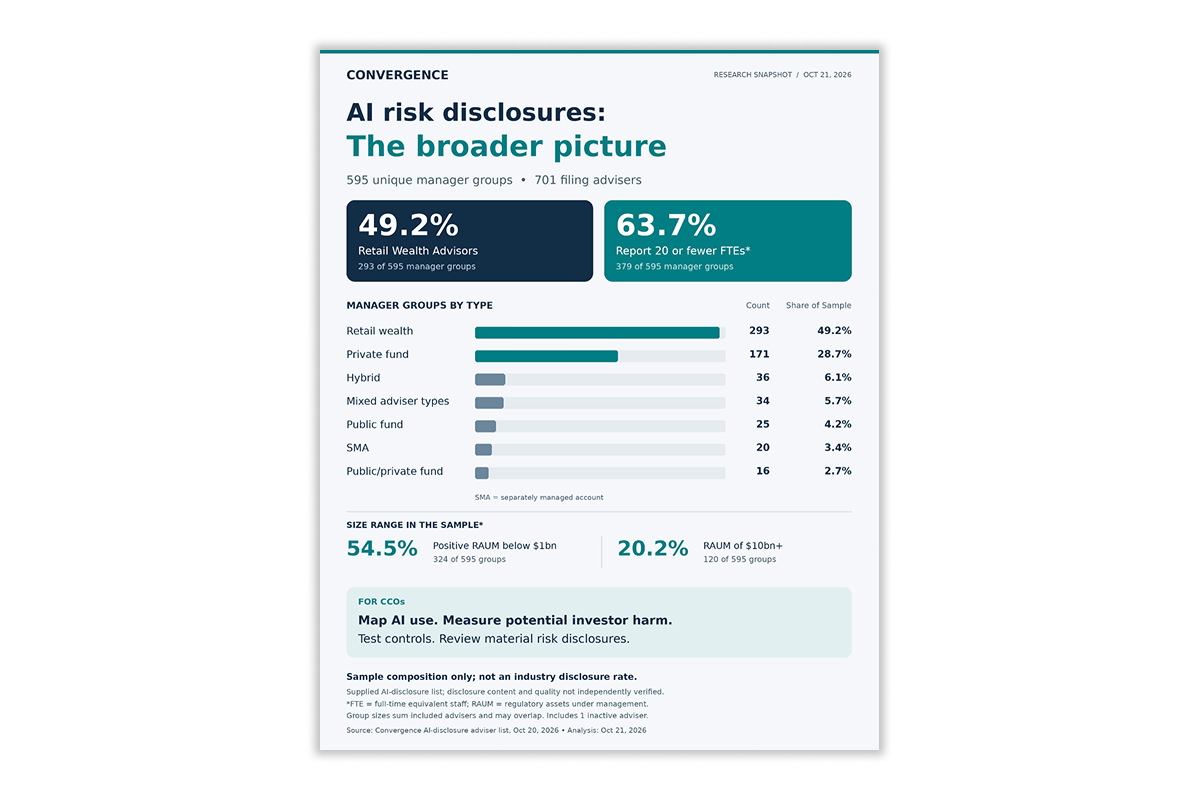
Of the filers with clear and direct AI risk disclosures, 49.2% are tagged retail wealth advisers, 63.7% have fewer than 20 employees, and 77.1% report less than $1 billion in RAUM.
Convergence identified them in just 2% of the brochures it tested.
It cites six reasons, including that the topic is new, the SEC’s focus is clear yet emerging, the industry has always been fire-ready-aim, and implementation is seen as too complicated and expensive.
Convergence believes they should: AI risk affects investment risk, it multiplies operational risk, and it says the complexity and cost to implement are extremely low.
Contact John Phinney or David Etzbach to learn how to evaluate AI risk in your organization.
On October 20, 2026, Convergence posted Part 1 of its study of risk disclosures in Form ADV Part 2A. It identified "clear and direct" AI risk disclosures in just 2% of the brochures we tested. Here is what we learned about these filers.
Read Part 1: www.convergenceinc.com/insights/is-your-form-adv-keeping-pace-with-ai
Profile of the filers with clear and direct AI risk disclosures
Why is AI risk disclosure so low when everyone seems to be using AI?
So, why does this low disclosure condition exist? Everyone seems to be using AI!
- The topic of AI governance, risk assessment and disclosures is new.
- The SEC's focus on the subject is clear yet "emerging."
- The application of newer technologies by the industry has always been "fire-ready-aim."
- Losses that occur and are discovered later are considered the "cost of innovation."
- Investors are more tolerant/sympathetic to their advisers on "emerging" risk issues.
- It's too complicated and expensive to implement.
Should investors and regulators have greater expectations of advisers on AI risk?
Convergence believes they should, because:
- AI risk impacts investment risk, which is what most investors emphasize.
- AI risk has a multiplier effect on operational risk, something that escapes most investors.
- The complexity and cost to implement is extremely low.
How can you evaluate AI risk in your organization?
Contact John Phinney or David Etzbach to learn how to evaluate AI risk in your organization.
Contact Convergence about evaluating AI risk
Or book time with John Phinney
About the data
Source: Convergence's study of risk disclosures in Form ADV Part 2A brochures, first reported in Part 1 on October 20, 2026. The percentages above describe the filers with clear and direct AI risk disclosures.
Key Points
Who discloses AI risk clearly?
- The finding. Convergence found clear and direct AI risk disclosures in just 2% of the brochures it tested.
- Retail wealth. 49.2% of these filers are tagged retail wealth advisers.
- The tag. Convergence defines the tag as 75%+ of RAUM being retail and high-net-worth.
- Small teams. 63.7% of these filers have fewer than 20 employees.
- Smaller assets. 77.1% of these filers report less than $1 billion in RAUM.
Why is disclosure so low?
- A new topic. AI governance, risk assessment and disclosures is new.
- An emerging focus. The SEC’s focus is clear yet emerging.
- Fire-ready-aim. The industry’s use of newer technologies has always been fire-ready-aim.
- Cost of innovation. Losses discovered later are considered the cost of innovation.
- Investor tolerance. Investors are more tolerant of and sympathetic to advisers on emerging risk issues.
- Perceived burden. Implementation is seen as too complicated and expensive.
Why does Convergence say expectations should be higher?
- Its position. Convergence believes investors and regulators should have greater expectations of advisers on AI risk.
- Investment risk. AI risk impacts investment risk, which is what most investors emphasize.
- Operational risk. AI risk has a multiplier effect on operational risk.
- Visibility. Convergence says that effect escapes most investors.
- Cost. Convergence says the complexity and cost to implement are extremely low.
What can advisers do?
- Contact. Contact John Phinney or David Etzbach.
- Goal. Learn how to evaluate AI risk in your organization.
- Part 1. Read Part 1 of the study for the 2% finding.
- Part 1’s approach. Map your AI use, assess the risk, and align your disclosures.
- Audience. The post is addressed to compliance professionals.